
Operational Inefficiencies
Manual processes and siloed operations lead to delays, errors, and higher costs.
Optimize operations. Enhance resilience. Deliver continuous value through scalable support, improved performance, and reliable technology that grows with your business.
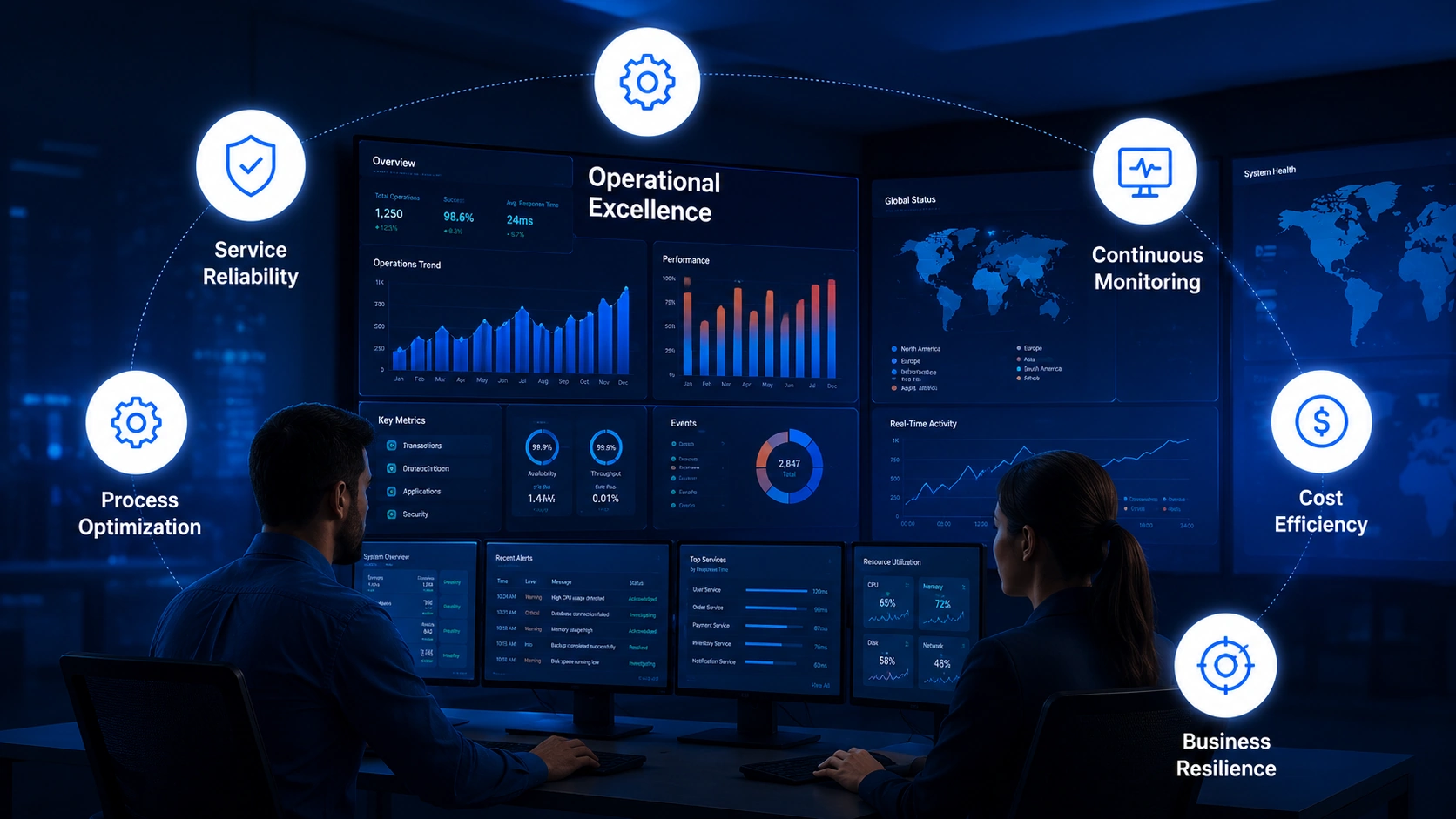
Manual processes and siloed operations lead to delays, errors, and higher costs.
System outages and performance issues impact productivity and customer satisfaction.
Evolving threats and regulatory requirements increase risk and complexity.
Limited monitoring and reporting make it hard to make informed, timely decisions.
Inefficient resource utilization and redundant efforts drive up total cost of operations.
Limited internal resources struggle to keep up with growth and demand.
Evaluate current operations, tools, and performance to identify gaps and improvement areas.
Define standardized processes, SLAs, and operating models aligned with business goals.
Seamlessly transition operations to managed services with minimal disruption.
Proactively monitor systems and processes 24/7 to ensure performance and availability.
Continuously optimize workflows, automate repetitive tasks, and improve efficiency.
Drive continuous improvement and adopt new technologies to future-proof operations.
Streamlined processes and optimized workflows increase productivity and reduce waste.
Proactive monitoring and incident management minimize downtime and disruptions.
Reliable operations and faster response times improve customer satisfaction and trust.
Optimized resources and automation reduce operational costs and improve ROI.
Robust controls and compliance management reduce risk and ensure regulatory adherence.
Scalable operations and resilient services enable faster response to change and growth.
Enterprise Operations encompass the people, processes, technologies, and governance practices that ensure an organization's day-to-day business and IT services operate efficiently, reliably, and securely. Enterprise Operations extend beyond traditional infrastructure management to include application operations, database administration, cloud operations, service management, monitoring, automation, incident response, performance optimization, and continuous operational improvement.
Modern organizations rely on Enterprise Operations to maintain business-critical applications, support employees and customers, protect digital assets, and deliver consistent service levels across increasingly complex technology environments. Effective Enterprise Operations integrate operational processes, automation, analytics, Artificial Intelligence, and governance to improve business performance while reducing operational risk.
As organizations continue their digital transformation journeys, Enterprise Operations have become a strategic business capability that enables operational resilience, business continuity, customer satisfaction, and sustainable organizational growth.
Enterprise Operations are essential because they ensure that business-critical systems, applications, databases, cloud platforms, and digital services remain available, secure, and optimized for continuous business performance. Every customer interaction, employee activity, financial transaction, and operational process depends on reliable enterprise operations.
Without effective operations management, organizations face increased downtime, slower response times, higher operational costs, security vulnerabilities, reduced employee productivity, and poor customer experiences. Enterprise Operations establish standardized operational processes, proactive monitoring, automation, and governance that minimize disruptions while improving service quality and operational efficiency.
Organizations with mature Enterprise Operations capabilities are better positioned to support digital transformation, respond to business changes quickly, improve customer satisfaction, reduce operational risk, and maximize the value of their technology investments.
IT Operations Management (ITOM) is the discipline responsible for managing, monitoring, optimizing, and supporting the technology infrastructure and operational services that enable business operations. ITOM ensures that enterprise applications, servers, databases, cloud platforms, networks, storage, and supporting technologies perform reliably while meeting agreed service levels.
ITOM includes infrastructure monitoring, application management, database administration, cloud operations, event management, incident management, performance optimization, capacity planning, automation, configuration management, and operational analytics. Modern ITOM platforms increasingly leverage Artificial Intelligence and automation to identify potential issues proactively, accelerate incident resolution, and optimize operational performance.
Organizations with mature IT Operations Management improve system availability, reduce downtime, strengthen service delivery, optimize infrastructure utilization, and support continuous digital business operations.
Business continuity depends on an organization's ability to maintain critical operations during planned maintenance, unexpected failures, cybersecurity incidents, natural disasters, or other business disruptions. Enterprise Operations provide the operational capabilities necessary to ensure essential business services remain available with minimal interruption.
Enterprise Operations support business continuity through proactive monitoring, high-availability architectures, backup and recovery processes, disaster recovery planning, cloud resilience, infrastructure redundancy, incident response procedures, operational automation, and continuous system health monitoring. These capabilities enable organizations to detect issues early, respond rapidly, and restore normal operations efficiently.
Rather than reacting to operational failures, mature Enterprise Operations focus on preventing disruptions before they impact the business. This proactive approach strengthens organizational resilience, protects revenue, maintains customer trust, and supports regulatory compliance.
High-performing IT operations consistently deliver secure, reliable, efficient, and business-aligned technology services that enable organizational success. Rather than measuring success solely by technical performance, leading organizations evaluate IT operations based on business outcomes, customer satisfaction, operational resilience, and continuous improvement.
Key characteristics include proactive monitoring, high system availability, automation, standardized operational processes, rapid incident response, effective problem management, strong cybersecurity, cloud optimization, performance management, service-level compliance, data-driven decision-making, continuous service improvement, and close alignment between business and technology teams. High-performing operations also embrace Artificial Intelligence, predictive analytics, and automation to identify potential issues before they affect business operations.
Organizations that build high-performing IT operations improve operational efficiency, reduce downtime, optimize technology investments, strengthen employee productivity, and create exceptional digital experiences for customers and stakeholders.
Managed IT Services are ongoing technology services delivered by a specialized provider that proactively manages, monitors, supports, and optimizes an organization's IT environment. Rather than relying solely on internal teams to maintain business-critical systems, organizations partner with managed services providers (MSPs) to ensure applications, databases, cloud environments, and supporting infrastructure remain secure, available, and high-performing.
Managed IT Services typically include application management, database administration, cloud operations, system monitoring, incident management, performance optimization, backup and recovery, patch management, operational reporting, and continuous service improvement. Modern managed services emphasize proactive support, automation, predictive monitoring, and business alignment instead of reactive break-fix support.
Organizations adopting managed services improve operational reliability, reduce technology risks, optimize IT spending, and enable internal teams to focus on strategic business initiatives rather than routine operational tasks.
Organizations outsource managed services to improve operational efficiency, reduce costs, strengthen service quality, and gain access to specialized expertise that may be difficult or expensive to maintain internally. As enterprise technology environments become increasingly complex, many organizations find it more effective to partner with experienced managed services providers that deliver around-the-clock operational support and continuous optimization.
Outsourcing managed services enables organizations to improve system availability, accelerate incident resolution, reduce operational risk, enhance cybersecurity, and ensure business-critical applications receive proactive monitoring and maintenance. Managed services also provide predictable operational costs, scalable support models, and access to experienced specialists across application management, database administration, cloud operations, and enterprise technologies.
Rather than replacing internal IT teams, managed services complement internal capabilities by allowing organizations to focus internal resources on innovation, business transformation, and strategic technology initiatives.
Organizations should consider outsourcing IT functions that require continuous monitoring, specialized expertise, standardized operational processes, or 24×7 support. The goal is not simply to reduce costs but to improve operational performance, increase service reliability, and allow internal teams to focus on initiatives that directly support business growth.
Commonly outsourced functions include application management, database administration, cloud operations, infrastructure monitoring, backup and recovery, operating system administration, patch management, incident management, service desk operations, performance monitoring, capacity planning, disaster recovery support, DevOps support, and routine maintenance activities. Organizations often retain strategic planning, enterprise architecture, business analysis, and technology governance internally while leveraging managed service providers for operational execution.
Successful outsourcing decisions are based on business criticality, required expertise, operational maturity, service-level expectations, security requirements, and long-term business objectives.
Managed Application Services provide proactive support, monitoring, maintenance, optimization, and lifecycle management for enterprise applications that support critical business operations. Rather than reacting to application issues after they occur, managed application services focus on preventing disruptions, improving performance, and ensuring applications continuously meet business requirements.
Services typically include application monitoring, incident resolution, performance tuning, patch management, release management, user support, root cause analysis, capacity planning, configuration management, and continuous application optimization. Organizations also benefit from improved service-level management, reduced downtime, faster issue resolution, and enhanced user experiences.
By leveraging managed application services, organizations improve application availability, reduce operational costs, strengthen business continuity, and extend the lifecycle of enterprise applications while enabling internal development teams to focus on innovation and modernization initiatives.
Managed Database Services provide ongoing administration, monitoring, optimization, security, backup, recovery, and performance management for enterprise databases. Because databases support mission-critical applications and business processes, proactive database management is essential for ensuring data availability, performance, security, and business continuity.
Managed database services typically include database administration (DBA), performance tuning, query optimization, backup and recovery, high availability configuration, patch management, security hardening, capacity planning, health monitoring, disaster recovery support, database upgrades, and operational reporting. These services help organizations reduce database-related risks while improving system reliability and application performance.
Organizations using managed database services benefit from increased database availability, faster issue resolution, optimized performance, stronger security, lower operational costs, and access to experienced database specialists without maintaining large in-house DBA teams.
Application management is the ongoing process of supporting, monitoring, maintaining, optimizing, and continuously improving enterprise applications throughout their lifecycle. While application development focuses on building software, application management ensures those applications remain reliable, secure, high-performing, and aligned with evolving business requirements after deployment.
Application management includes application monitoring, incident management, problem management, performance tuning, patch management, release management, configuration management, user support, capacity planning, security updates, and continuous service improvement. Modern application management also incorporates automation, Artificial Intelligence, DevSecOps practices, and predictive monitoring to proactively identify and resolve issues before they affect business operations.
Organizations with mature application management practices improve system availability, increase user satisfaction, reduce downtime, extend application lifespan, and maximize the return on enterprise software investments.
Proactive application monitoring enables organizations to identify and resolve potential performance issues before they impact employees, customers, or business operations. Instead of waiting for users to report problems, monitoring platforms continuously track application health, availability, response times, transactions, infrastructure utilization, database performance, and system behavior in real time.
Modern monitoring solutions leverage Artificial Intelligence, predictive analytics, anomaly detection, automated alerting, and operational dashboards to identify performance degradation, infrastructure bottlenecks, security concerns, and abnormal application behavior. Early detection significantly reduces downtime, accelerates incident resolution, and improves service reliability.
Organizations that adopt proactive monitoring strengthen operational resilience, improve user experiences, reduce support costs, and maintain higher service availability while enabling IT teams to focus on continuous optimization rather than reactive troubleshooting.
Enterprise application performance optimization is the continuous process of improving application responsiveness, scalability, reliability, and efficiency to support business operations and user expectations. Poor application performance affects employee productivity, customer satisfaction, operational efficiency, and overall business performance.
Organizations optimize application performance through performance monitoring, database tuning, code optimization, API optimization, infrastructure scaling, cloud auto-scaling, caching, load balancing, capacity planning, application profiling, and continuous performance testing. Modern organizations also utilize Artificial Intelligence and observability platforms to detect performance anomalies and recommend optimization opportunities before users experience service degradation.
Application performance optimization should be treated as an ongoing operational discipline rather than a one-time activity. Continuous improvement ensures enterprise applications remain responsive as user demand, transaction volumes, and business requirements evolve.
Database Administration (DBA) is the discipline responsible for managing, securing, monitoring, maintaining, and optimizing enterprise databases that support business-critical applications. Database administrators ensure organizational data remains available, accurate, secure, and high-performing while supporting operational continuity and regulatory compliance.
DBA responsibilities include database installation, configuration, performance tuning, query optimization, backup and recovery, disaster recovery planning, security management, user access control, database patching, capacity planning, replication, high availability, health monitoring, and database upgrades. Modern database administration also incorporates cloud database management, automation, predictive monitoring, and AI-assisted optimization.
As enterprise data volumes continue growing, effective database administration becomes increasingly important for maintaining application performance, protecting business information, and ensuring operational resilience.
Managed Database Services are important because enterprise databases represent one of the most valuable assets within an organization, supporting critical business applications, financial systems, customer information, analytics, and operational processes. Database failures, poor performance, or security vulnerabilities can significantly impact business continuity and customer trust.
Managed database services provide continuous monitoring, database administration, performance tuning, security hardening, backup and recovery, disaster recovery support, patch management, health assessments, capacity planning, cloud database management, and ongoing optimization. These proactive services help organizations prevent issues before they affect business operations while reducing the need for large in-house database administration teams.
Organizations leveraging managed database services improve system availability, strengthen cybersecurity, optimize database performance, reduce operational costs, and ensure their data platforms continue supporting evolving business requirements.
Proactive monitoring is the continuous observation of enterprise applications, databases, infrastructure, cloud environments, and business services to detect potential issues before they affect users or disrupt business operations. Unlike reactive monitoring, which responds only after failures occur, proactive monitoring identifies performance degradation, capacity constraints, abnormal behavior, and security events early, allowing IT teams to take preventive action.
Modern proactive monitoring combines Application Performance Monitoring (APM), infrastructure monitoring, log analytics, Artificial Intelligence (AI), predictive analytics, anomaly detection, and automated alerting to provide real-time operational visibility. Organizations can monitor application response times, database performance, cloud resources, API availability, user transactions, and service health through centralized operational dashboards.
Organizations that implement proactive monitoring improve service reliability, reduce downtime, accelerate issue resolution, optimize system performance, and strengthen business continuity while providing better digital experiences for employees and customers.
Application downtime directly affects business operations, employee productivity, customer satisfaction, and revenue generation. Reducing downtime requires a proactive operational strategy that emphasizes prevention, rapid detection, automated recovery, and continuous optimization rather than simply responding after failures occur.
Organizations reduce downtime through proactive monitoring, high-availability architecture, redundancy, automated failover, load balancing, disaster recovery planning, infrastructure resilience, database replication, preventive maintenance, patch management, performance optimization, and regular health assessments. Incident response procedures, root cause analysis, and continuous service improvement further reduce recurring issues and improve overall system reliability.
Modern organizations also leverage Artificial Intelligence for IT Operations (AIOps), predictive analytics, and automation to identify potential failures before they impact production environments. This proactive operational model significantly improves service continuity and minimizes business disruption.
Incident Management is the structured process of identifying, recording, prioritizing, responding to, and resolving unplanned service interruptions or performance degradation that impact business operations. The primary objective of incident management is to restore normal service as quickly as possible while minimizing business disruption and maintaining agreed service levels.
A mature incident management process includes automated alerting, incident classification, prioritization based on business impact, escalation procedures, communication protocols, root cause documentation, resolution tracking, and post-incident reviews. Modern IT Service Management (ITSM) platforms integrate incident management with monitoring systems, knowledge bases, automation, and Artificial Intelligence to accelerate diagnosis and resolution.
Organizations with effective incident management reduce Mean Time to Detect (MTTD), Mean Time to Resolve (MTTR), improve customer satisfaction, strengthen operational resilience, and maintain high levels of service availability.
Problem Management is the process of identifying, analyzing, and eliminating the underlying root causes of recurring incidents to prevent future service disruptions. While incident management focuses on restoring service quickly, problem management focuses on long-term operational improvement by permanently resolving systemic issues.
Problem management includes trend analysis, root cause analysis (RCA), knowledge management, corrective action planning, change recommendations, and continuous improvement initiatives. Organizations use operational data, incident history, performance metrics, and analytics to identify recurring issues and implement permanent solutions rather than repeatedly addressing symptoms.
Effective problem management improves service stability, reduces operational costs, minimizes recurring incidents, strengthens customer satisfaction, and supports continuous operational excellence by preventing future disruptions before they occur.
Service availability measures the ability of enterprise applications and business services to remain operational and accessible whenever users require them. High service availability is essential for maintaining business continuity, supporting customer experiences, and ensuring mission-critical operations continue without interruption.
Organizations improve service availability through resilient system architecture, proactive monitoring, high-availability infrastructure, redundancy, automated failover, disaster recovery planning, capacity planning, preventive maintenance, performance optimization, cloud resilience, database replication, and continuous operational monitoring. Service availability also depends on well-defined Service Level Agreements (SLAs), operational governance, incident management, and ongoing service improvement.
Organizations that prioritize availability create resilient technology environments capable of supporting business growth, reducing operational risk, and delivering consistent digital experiences across enterprise applications and customer-facing platforms.
Automation improves IT operations by eliminating repetitive manual tasks, accelerating service delivery, reducing operational errors, and enabling IT teams to focus on higher-value strategic initiatives. As enterprise environments become more complex, automation helps organizations manage applications, databases, cloud platforms, and operational workflows more efficiently while maintaining consistent service quality.
Organizations commonly automate system monitoring, alert management, incident response, patch deployment, application releases, database maintenance, backup and recovery, user provisioning, infrastructure provisioning, compliance checks, and operational reporting. Modern automation platforms also integrate with Artificial Intelligence to proactively detect issues, trigger corrective actions, and optimize operational workflows with minimal human intervention.
By automating routine operational activities, organizations improve service reliability, increase operational consistency, reduce costs, accelerate issue resolution, and create scalable IT operations capable of supporting continuous business growth.
IT Operations Automation (ITOA) is the use of software, workflows, scripts, orchestration platforms, and intelligent technologies to automate routine operational processes across enterprise IT environments. Rather than relying on manual intervention, organizations automate operational tasks to improve efficiency, reduce risk, and accelerate service delivery.
IT operations automation typically includes automated infrastructure provisioning, server configuration, application deployments, database maintenance, cloud resource management, monitoring, incident response, backup scheduling, patch management, security compliance, capacity scaling, and operational reporting. Many organizations combine automation with Artificial Intelligence and AIOps to create intelligent operational environments capable of self-monitoring and self-healing.
Organizations implementing IT operations automation improve operational agility, reduce service interruptions, lower operational costs, strengthen compliance, and enable faster response to changing business requirements.
Operational efficiency is achieved when organizations optimize people, processes, technology, and resources to deliver better business outcomes with fewer delays, lower costs, and higher service quality. High-performing organizations continuously evaluate their operations to eliminate inefficiencies, automate repetitive work, improve collaboration, and optimize technology utilization.
Key strategies include business process automation, application optimization, proactive monitoring, performance management, standardized operational procedures, cloud optimization, IT Service Management (ITSM), Artificial Intelligence, analytics, continuous improvement initiatives, and operational governance. Organizations also measure performance using KPIs, service-level agreements (SLAs), and operational dashboards to identify opportunities for ongoing optimization.
Improving operational efficiency is not a one-time initiative—it is a continuous process of evaluating performance, implementing improvements, and adapting operations as business needs evolve. Organizations that embrace operational excellence become more agile, productive, and competitive.
Infrastructure performance optimization ensures that enterprise computing resources—including servers, storage, networks, cloud platforms, databases, and virtual environments—operate efficiently, reliably, and at peak performance. Well-optimized infrastructure improves application responsiveness, reduces operational costs, and supports business continuity.
Organizations optimize infrastructure through continuous monitoring, resource utilization analysis, performance tuning, cloud optimization, workload balancing, infrastructure automation, virtualization, capacity planning, network optimization, storage management, preventive maintenance, and proactive hardware and software upgrades. Modern observability platforms provide real-time visibility into infrastructure health, enabling IT teams to identify bottlenecks before they affect business services.
Infrastructure optimization is an ongoing operational discipline that ensures enterprise technology can support growing workloads, new applications, and evolving business demands without compromising reliability or performance.
Capacity planning is the process of forecasting future technology resource requirements to ensure enterprise systems can support anticipated business growth, user demand, application workloads, and digital transformation initiatives. Effective capacity planning prevents both underutilization and resource shortages while optimizing technology investments.
Capacity planning evaluates infrastructure utilization, application workloads, database growth, network bandwidth, cloud resources, storage requirements, processing capacity, and future business initiatives. Organizations use historical trends, predictive analytics, business forecasts, and performance monitoring data to anticipate future capacity needs and proactively allocate resources.
Organizations with mature capacity planning practices improve application performance, reduce infrastructure costs, avoid service disruptions, support business expansion, and ensure technology resources remain aligned with evolving organizational requirements.
IT Service Management (ITSM) is a structured approach to designing, delivering, managing, and continuously improving IT services so they consistently meet business needs. Rather than focusing solely on technology infrastructure, ITSM emphasizes delivering high-quality business services through standardized processes, governance, automation, and continual improvement.
ITSM encompasses disciplines such as incident management, problem management, change management, service request management, configuration management, knowledge management, asset management, service catalog management, and service-level management. Modern ITSM platforms integrate automation, Artificial Intelligence, self-service portals, and analytics to improve service quality, operational efficiency, and user satisfaction.
Organizations that adopt mature ITSM practices improve operational consistency, accelerate issue resolution, reduce service disruptions, strengthen business alignment, and create a service-oriented IT organization capable of supporting digital transformation and long-term business growth.
ITIL (Information Technology Infrastructure Library) is one of the world's most widely adopted frameworks for IT Service Management. It provides a comprehensive set of best practices for designing, delivering, operating, and continually improving IT services while aligning technology operations with business objectives.
ITIL helps organizations establish standardized processes for incident management, problem management, change management, service request fulfillment, configuration management, service asset management, knowledge management, and continual improvement. By adopting ITIL principles, organizations improve service reliability, increase operational efficiency, strengthen governance, and create a consistent customer-focused service culture.
While ITIL provides proven best practices, successful organizations adapt the framework to fit their operational maturity, business objectives, and organizational culture rather than implementing every process exactly as defined.
Service Level Agreements (SLAs) are formal agreements that define the expected level of service between a service provider and its customers. SLAs establish measurable performance commitments, clarify responsibilities, and create accountability for delivering reliable, high-quality IT services.
Typical SLA metrics include system availability, application uptime, response times, resolution times, incident priorities, service request fulfillment, maintenance windows, backup success rates, disaster recovery objectives, and customer support responsiveness. Well-designed SLAs also define reporting requirements, escalation procedures, service credits where applicable, and performance review processes.
SLAs enable organizations to measure service quality objectively while ensuring business expectations are clearly communicated and consistently met. They also provide a foundation for continuous service improvement and stronger business-provider relationships.
Service delivery improves when organizations consistently provide reliable, efficient, and customer-focused IT services that support business objectives. High-performing organizations continuously evaluate operational performance, user satisfaction, service quality, and business outcomes to identify opportunities for improvement.
Key service delivery improvements include implementing ITSM best practices, standardizing operational processes, automating repetitive tasks, strengthening incident and problem management, improving knowledge management, enhancing self-service capabilities, proactively monitoring services, optimizing application performance, establishing meaningful SLAs, and leveraging analytics to support data-driven decision-making.
Organizations that prioritize service excellence improve employee productivity, increase customer satisfaction, reduce operational costs, strengthen business continuity, and build greater confidence in enterprise technology services.
Continuous Service Improvement (CSI) is the ongoing process of evaluating, measuring, and enhancing IT services to ensure they continue meeting changing business requirements and customer expectations. Rather than treating operational excellence as a one-time achievement, CSI establishes a culture of continuous learning, measurement, and incremental improvement.
CSI uses operational metrics, service reviews, incident trends, customer feedback, root cause analysis, performance dashboards, and business outcomes to identify opportunities for improving service quality, operational efficiency, automation, and user experiences. Improvements may include refining operational processes, optimizing applications, updating service workflows, enhancing monitoring capabilities, or introducing new automation technologies.
Organizations that embed CSI into their operational culture become more agile, responsive, and resilient. Continuous improvement enables Enterprise Operations to evolve alongside business growth, emerging technologies, and changing customer expectations.
Cloud Operations (CloudOps) is the discipline of managing, monitoring, optimizing, securing, and supporting cloud infrastructure, cloud-native applications, and cloud services throughout their operational lifecycle. CloudOps ensures that cloud environments remain reliable, scalable, secure, and cost-efficient while continuously supporting business operations and digital transformation initiatives.
CloudOps includes cloud provisioning, infrastructure automation, monitoring, security management, identity and access management (IAM), backup and disaster recovery, performance optimization, cloud governance, compliance monitoring, patch management, and resource scaling. Modern CloudOps also incorporates Infrastructure as Code (IaC), DevSecOps, Artificial Intelligence, observability platforms, and automated remediation to improve operational efficiency.
Organizations with mature CloudOps capabilities improve application availability, optimize cloud utilization, strengthen security, accelerate service delivery, and maximize the value of cloud investments while enabling continuous business innovation.
Hybrid IT environments combine on-premises infrastructure with public and private cloud services, allowing organizations to leverage existing technology investments while adopting modern cloud capabilities. Managing hybrid environments requires consistent governance, centralized monitoring, secure connectivity, standardized operations, and seamless integration across diverse technology platforms.
Organizations manage hybrid environments through centralized management platforms, cloud management tools, API-based integration, infrastructure automation, identity and access management, unified monitoring, configuration management, and standardized operational procedures. Hybrid operations also require consistent security policies, disaster recovery planning, performance optimization, and workload orchestration across both cloud and on-premises systems.
A well-managed hybrid environment enables organizations to modernize incrementally, improve business flexibility, strengthen operational resilience, and optimize technology investments without disrupting business operations.
Managing cloud applications involves ensuring that Software-as-a-Service (SaaS), Platform-as-a-Service (PaaS), and cloud-native applications remain secure, available, high-performing, and aligned with business objectives. Unlike traditional applications, cloud applications require continuous operational management across multiple cloud providers, deployment models, and business environments.
Cloud application management includes performance monitoring, availability management, identity and access management, security monitoring, patch management, release management, API management, capacity optimization, user support, backup and recovery, compliance management, and continuous application optimization. Organizations increasingly use observability platforms, AIOps, automation, and centralized dashboards to manage complex cloud application portfolios efficiently.
Effective cloud application management ensures reliable digital services, improves user experiences, strengthens security, and supports continuous innovation while maximizing cloud platform performance.
FinOps (Cloud Financial Operations) is a collaborative operational framework that helps organizations manage, optimize, and govern cloud spending while maximizing the business value of cloud investments. FinOps brings together finance, IT, engineering, operations, and business leaders to improve financial accountability and optimize cloud resource utilization.
FinOps practices include cloud cost visibility, budgeting, forecasting, resource optimization, rightsizing, reserved instance planning, workload scheduling, cost allocation, governance, performance analysis, and financial reporting. Rather than simply reducing costs, FinOps focuses on making informed cloud investment decisions that balance performance, scalability, innovation, and financial efficiency.
Organizations adopting FinOps improve cloud cost transparency, reduce unnecessary spending, strengthen executive decision-making, and ensure cloud investments align with business priorities and operational objectives.
Cloud cost optimization is the continuous process of improving cloud resource utilization while maintaining performance, security, scalability, and business continuity. As cloud adoption increases, organizations must actively manage cloud consumption to avoid unnecessary expenses and maximize the return on cloud investments.
Cloud cost optimization strategies include rightsizing compute resources, eliminating unused infrastructure, implementing auto-scaling, leveraging reserved and savings plans, optimizing storage tiers, scheduling non-production workloads, improving application efficiency, monitoring cloud utilization, implementing FinOps practices, and establishing governance policies for cloud resource provisioning. Organizations should also regularly review cloud spending using dashboards, analytics, and cost management tools.
Effective cloud cost optimization enables organizations to control expenses without compromising service quality, operational agility, or future growth. Cost optimization should become an ongoing operational discipline rather than a one-time cost reduction exercise.
Enterprise Operations should be measured using business-focused Key Performance Indicators (KPIs) that demonstrate how operational performance contributes to organizational success. While technical metrics remain important, executive leaders should prioritize KPIs that reflect business continuity, service quality, operational efficiency, customer satisfaction, and financial performance.
Common Enterprise Operations KPIs include system availability, application uptime, Mean Time to Detect (MTTD), Mean Time to Resolve (MTTR), incident volume, service-level agreement (SLA) compliance, change success rate, application response times, infrastructure utilization, database performance, cloud resource efficiency, operational automation rates, customer satisfaction (CSAT), service request fulfillment times, operational costs, and employee productivity. Organizations should also monitor business continuity metrics such as disaster recovery readiness and recovery time objectives (RTOs).
Executive dashboards that combine operational and business metrics enable leaders to identify trends, prioritize investments, and continuously improve service delivery while aligning operational performance with strategic business goals.
Managed services success is measured by the provider's ability to consistently deliver reliable, secure, high-quality services that improve business performance while meeting agreed service levels. Success extends beyond resolving technical issues—it includes enhancing operational efficiency, reducing risk, improving customer satisfaction, and enabling long-term business value.
Organizations evaluate managed services using metrics such as SLA compliance, application availability, incident response and resolution times, first-call resolution, customer satisfaction, infrastructure performance, proactive issue prevention, automation adoption, operational cost savings, security performance, business continuity readiness, and continuous service improvement initiatives. Executive reviews should also assess strategic outcomes such as improved productivity, reduced downtime, technology modernization, and alignment with business objectives.
The most successful managed services relationships are built on transparency, measurable performance, continuous improvement, and long-term strategic partnership rather than transactional support.
The Return on Investment (ROI) of managed services is realized through improved operational efficiency, reduced downtime, optimized technology utilization, lower operational costs, and increased business productivity. Rather than simply reducing headcount or outsourcing routine tasks, managed services create measurable value by improving service reliability, strengthening operational resilience, and enabling internal teams to focus on strategic initiatives.
Organizations achieve ROI through proactive monitoring, faster incident resolution, automation, optimized application performance, improved database management, reduced infrastructure maintenance, enhanced cybersecurity, predictable operational costs, and minimized business disruption. Managed services also reduce the financial impact of unplanned outages, delayed projects, inefficient resource utilization, and technology failures.
A comprehensive ROI assessment should evaluate financial savings alongside strategic benefits such as business continuity, customer satisfaction, operational scalability, technology modernization, and improved organizational agility.
Managed services reduce operational costs by providing specialized expertise, standardized operational processes, automation, and proactive support that improve efficiency while minimizing business disruption. Instead of maintaining large internal operational teams for every technology discipline, organizations leverage experienced managed services providers to deliver consistent operational excellence at predictable costs.
Cost reductions are achieved through automation, proactive monitoring, reduced downtime, faster issue resolution, optimized infrastructure utilization, preventive maintenance, cloud optimization, database performance tuning, standardized operational procedures, and improved resource allocation. Managed services also help organizations avoid unnecessary capital expenditures while reducing the costs associated with emergency support, system failures, and inefficient operational practices.
By transforming operational management from reactive to proactive, organizations improve technology performance while creating sustainable operational cost efficiencies that support long-term business growth.
Business resilience is an organization's ability to continue delivering critical services despite operational disruptions, cybersecurity incidents, infrastructure failures, or changing business conditions. Enterprise Operations play a central role in building resilience by ensuring technology environments remain reliable, secure, recoverable, and continuously available.
Enterprise Operations strengthen resilience through proactive monitoring, incident management, disaster recovery planning, backup management, high-availability architecture, cloud resilience, cybersecurity operations, infrastructure redundancy, operational automation, capacity planning, and continuous service improvement. These capabilities enable organizations to anticipate operational risks, respond quickly to disruptions, and recover efficiently while minimizing business impact.
Organizations with mature Enterprise Operations are better prepared to support digital transformation, regulatory compliance, evolving customer expectations, and unexpected business events. Operational resilience becomes a strategic competitive advantage that protects organizational performance and customer trust.
Artificial Intelligence (AI) is fundamentally transforming IT operations by enabling organizations to move from reactive support models to intelligent, predictive, and increasingly autonomous operations. Rather than relying solely on manual monitoring and troubleshooting, AI continuously analyzes operational data to detect anomalies, predict potential failures, automate routine tasks, and recommend corrective actions before business services are affected.
Organizations are using AI to improve application monitoring, infrastructure management, database optimization, incident response, capacity planning, cybersecurity monitoring, cloud operations, and service desk automation. AI-powered operational platforms identify patterns across logs, metrics, events, and user behavior, helping IT teams resolve issues faster while reducing operational complexity.
As enterprise environments become more distributed and cloud-centric, AI enables IT operations teams to improve service quality, reduce downtime, optimize resource utilization, and deliver more resilient digital services that support business growth.
AIOps (Artificial Intelligence for IT Operations) combines Artificial Intelligence, machine learning, automation, and advanced analytics to enhance IT operations management. AIOps platforms continuously collect and analyze operational data from applications, infrastructure, cloud platforms, databases, networks, and monitoring tools to detect issues, identify root causes, predict failures, and automate operational responses.
Unlike traditional monitoring systems that generate thousands of alerts, AIOps correlates events, filters operational noise, prioritizes critical incidents, and provides actionable recommendations. Many AIOps platforms can automatically trigger remediation workflows, reducing Mean Time to Detect (MTTD) and Mean Time to Resolve (MTTR).
Organizations adopting AIOps improve operational visibility, reduce downtime, increase automation, optimize resource utilization, and strengthen business resilience. As enterprise environments continue to grow in complexity, AIOps is becoming a foundational capability for modern Enterprise Operations.
Predictive analytics improves Enterprise Operations by using historical and real-time operational data to forecast future events, identify emerging risks, and anticipate resource requirements before problems occur. Rather than reacting to failures, organizations use predictive insights to proactively optimize performance and prevent operational disruptions.
Predictive analytics supports infrastructure capacity planning, application performance optimization, database growth forecasting, hardware maintenance, cloud resource management, cybersecurity monitoring, incident prevention, and business continuity planning. By identifying trends and potential issues early, organizations can allocate resources more effectively, reduce downtime, and improve operational decision-making.
Organizations that integrate predictive analytics into Enterprise Operations improve service reliability, reduce maintenance costs, optimize technology investments, and create more resilient operational environments capable of adapting to changing business demands.
Enterprise Operations continue evolving through the adoption of emerging technologies that improve automation, intelligence, operational visibility, and service delivery. Organizations should evaluate these technologies based on measurable business outcomes rather than technology trends alone.
Key technologies shaping Enterprise Operations include Artificial Intelligence, AIOps, Generative AI, intelligent automation, robotic process automation (RPA), cloud-native operations, Infrastructure as Code (IaC), observability platforms, digital twins, edge computing, Internet of Things (IoT), predictive analytics, autonomous infrastructure management, platform engineering, Zero Trust security, and advanced operational analytics. These technologies improve operational efficiency while enabling faster, more reliable business services.
Organizations that strategically adopt emerging operational technologies strengthen business resilience, reduce operational costs, improve service quality, and create agile operations capable of supporting continuous digital transformation.
The future of managed services is evolving beyond traditional infrastructure support toward intelligent, outcome-driven operational partnerships that combine automation, Artificial Intelligence, cloud expertise, analytics, cybersecurity, and continuous optimization. Organizations increasingly expect managed service providers to deliver measurable business outcomes rather than simply maintaining technology environments.
Future managed services will emphasize predictive monitoring, AIOps, autonomous operations, cloud optimization, FinOps, intelligent automation, application modernization support, continuous performance improvement, operational analytics, cybersecurity operations, and business resilience. Service providers will increasingly leverage AI to automate routine operational tasks while providing strategic advisory services that help organizations maximize technology investments.
As digital transformation accelerates, managed services will become strategic business partnerships focused on enabling innovation, improving operational excellence, and supporting sustainable organizational growth rather than simply providing technical support.
Selecting the right Managed Services Provider (MSP) is a strategic business decision that extends beyond technical capabilities. The ideal provider should understand the organization's business objectives, operational challenges, compliance requirements, and long-term technology strategy while delivering reliable, measurable, and scalable operational support.
Organizations should evaluate providers based on industry expertise, technical certifications, service portfolio, 24×7 operational support, Service Level Agreements (SLAs), security capabilities, cloud expertise, automation maturity, Artificial Intelligence (AI) capabilities, customer references, governance practices, reporting transparency, and continuous improvement methodologies. It is equally important to assess cultural fit, communication practices, executive engagement, and the provider's ability to function as a long-term strategic partner.
The most successful managed services relationships are built on trust, accountability, measurable business outcomes, and continuous innovation—not simply outsourced operational support.
An Enterprise Operations strategy defines how technology operations will support business growth, operational resilience, customer experience, and digital transformation. Rather than focusing only on infrastructure management, a modern operations strategy aligns operational capabilities with organizational objectives and measurable business outcomes.
A comprehensive Enterprise Operations strategy should include operational governance, IT Service Management (ITSM), managed services, application management, database administration, CloudOps, hybrid infrastructure management, cybersecurity operations, business continuity planning, disaster recovery, automation, AIOps, FinOps, performance management, SLA governance, operational KPIs, workforce planning, vendor management, and continuous service improvement. The strategy should also define modernization priorities, investment roadmaps, risk management, and executive reporting mechanisms.
Organizations with well-defined operations strategies create resilient, scalable operational environments capable of supporting innovation while ensuring reliable day-to-day business operations.
A managed services partner should provide far more than technical support—they should become an extension of the organization's technology leadership team. The right partner combines operational excellence, technical expertise, strategic advisory services, and continuous innovation to improve business performance over time.
Organizations should evaluate managed services partners based on their expertise in enterprise applications, cloud operations, database administration, cybersecurity, ITSM, automation, Artificial Intelligence, AIOps, operational monitoring, disaster recovery, compliance, reporting, governance, and continuous improvement. Additional considerations include service flexibility, scalability, knowledge transfer, transparent communication, executive reporting, and a proven track record of delivering measurable business outcomes.
The strongest partnerships are collaborative, proactive, and focused on helping organizations continuously optimize technology operations rather than simply responding to support requests.
Operational excellence begins with understanding the organization's current operational maturity and identifying opportunities to improve efficiency, reliability, service quality, and business alignment. Rather than implementing isolated technology improvements, organizations should establish a structured roadmap for continuous operational improvement.
The first steps include conducting an Enterprise Operations assessment, evaluating application and infrastructure performance, reviewing operational processes, measuring service-level performance, assessing monitoring capabilities, analyzing incident and problem trends, identifying automation opportunities, reviewing cloud operations, evaluating cybersecurity readiness, and establishing operational KPIs. Organizations should then prioritize initiatives that deliver measurable business value while building a culture of continuous improvement.
Operational excellence is not a destination but an ongoing capability. Organizations that continuously optimize operations become more resilient, agile, efficient, and better prepared to support future business growth.
Organizations choose SRISYS because we view Enterprise Operations as a strategic business capability that drives operational excellence, business resilience, and long-term digital success. Our Enterprise Operations & Managed Services™ (EOMS™) practice combines proactive operational management, modern automation, cloud expertise, and continuous optimization to help organizations maximize the performance and reliability of mission-critical technology environments.
Our expertise includes Managed IT Services, Managed Application Services, Managed Database Services, IT Operations Management (ITOM), CloudOps, Hybrid IT Operations, Application Performance Monitoring (APM), Database Administration (DBA), IT Service Management (ITSM), ITIL-aligned operations, AIOps, FinOps, infrastructure monitoring, incident and problem management, operational automation, business continuity, disaster recovery, and continuous service improvement.
Unlike traditional support providers, SRISYS delivers business-first managed services focused on measurable outcomes. We partner with executive leadership to improve system availability, reduce operational costs, optimize cloud investments, strengthen cybersecurity, automate routine operations, and continuously improve service delivery. Our proactive, SLA-driven approach enables organizations to reduce operational risk, increase business agility, and ensure enterprise technology consistently supports strategic growth.
Take the 10-minute SRISYS Enterprise Assessment and receive a customized executive report with actionable recommendations.