
Siloed Systems & Data
Disconnected systems create data silos and limit enterprise visibility.
Design connected, future-ready architectures and seamless enterprise integrations that unify systems and data. Align technology investments with business strategies to improve agility, scalability, and long-term growth.
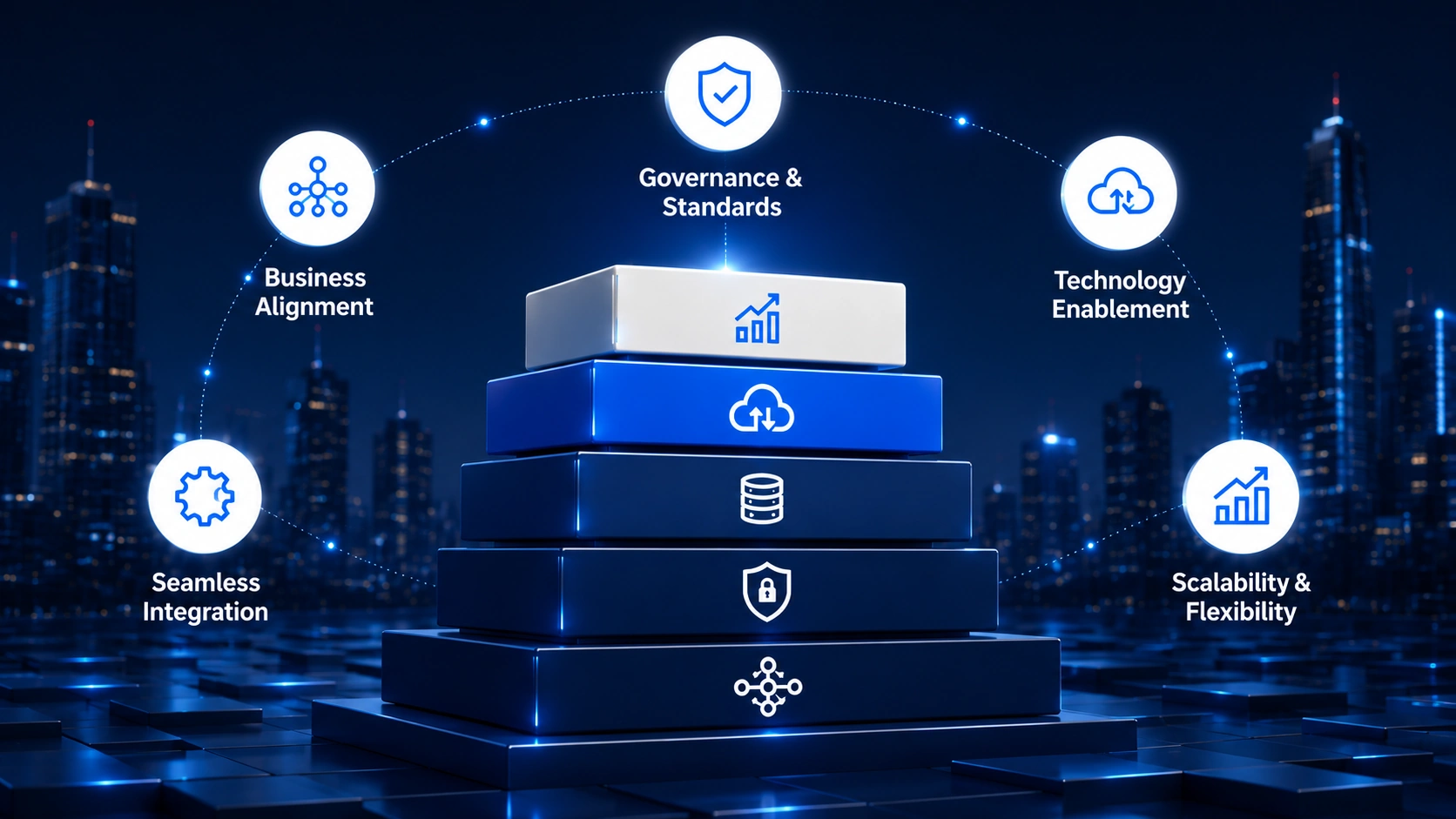
Disconnected systems create data silos and limit enterprise visibility.
Overly complex landscapes increase integration efforts and operational risk.
Inconsistent standards and weak governance lead to duplication and inefficiency.
Point-to-point integrations cause delays, errors, and limit scalability.
Rigid architectures make it hard to adapt to change and support growth.
Redundant technologies and manual processes drive up costs and debt.
Assess current state, business capabilities, and target architecture alignment.
Design future-state architecture with standards, principles, and reference models.
Define integration patterns, data flows, and interface strategies.
Build reusable services and integrate systems securely and efficiently.
Establish governance, monitor performance, and ensure compliance.
Continuously improve architecture and adopt emerging technologies.
Ensure technology architecture directly supports business objectives.
Streamline integrations and processes to improve operational efficiency.
Build flexible architectures that adapt and scale with business needs.
Eliminate redundancies and lower total cost of ownership across the enterprise.
Enforce standards and governance for security, quality, and compliance.
Enable new capabilities and faster time-to-market for innovative solutions.
Enterprise Architecture (EA) is a strategic discipline that aligns business strategy, people, processes, information, applications, and technology to help organizations achieve their long-term objectives. Rather than focusing on individual technology projects, Enterprise Architecture provides a holistic blueprint that guides how the entire organization evolves, ensuring business and technology investments work together to deliver measurable value.
Enterprise Architecture establishes standards, governance, roadmaps, and architectural principles that enable organizations to modernize systems, improve operational efficiency, reduce technology complexity, and support innovation. It provides executives with a structured approach for making informed investment decisions while ensuring technology initiatives remain aligned with business priorities.
As organizations accelerate digital transformation, Enterprise Architecture has become a critical business capability that improves agility, supports enterprise-wide integration, reduces technical debt, and creates scalable digital ecosystems capable of adapting to changing business needs.
Enterprise Architecture is important because it enables organizations to make strategic technology decisions that directly support business objectives. Without Enterprise Architecture, organizations often develop disconnected systems, duplicate technologies, inconsistent processes, and complex IT environments that increase operational costs and slow innovation.
A well-defined Enterprise Architecture creates a common framework for evaluating technology investments, integrating enterprise systems, managing business change, and governing digital transformation initiatives. It improves collaboration between business and technology leaders while providing visibility into how applications, infrastructure, data, and business capabilities interact across the enterprise.
Organizations that invest in Enterprise Architecture improve business agility, strengthen governance, reduce technology risk, accelerate modernization initiatives, and maximize the value of digital investments. Enterprise Architecture enables organizations to respond more effectively to changing market conditions while supporting sustainable business growth.
Enterprise Architecture is typically organized into several interconnected domains that collectively define how an organization operates and evolves. Each domain addresses a different aspect of the enterprise while ensuring all technology investments remain aligned with business strategy and organizational objectives.
The core components include Business Architecture, which defines business capabilities, operating models, and organizational processes; Application Architecture, which governs enterprise applications and software ecosystems; Data Architecture, which manages enterprise information, governance, and analytics; and Technology Architecture, which defines infrastructure, cloud platforms, networks, security, and supporting technologies. Many organizations also incorporate Security Architecture, Integration Architecture, and Solution Architecture to support increasingly complex digital environments.
Together, these architectural domains provide a comprehensive blueprint for managing technology, improving interoperability, reducing technical debt, and supporting continuous business transformation.
Enterprise Architecture transforms business strategy into executable technology initiatives by ensuring that enterprise capabilities, applications, data, and infrastructure directly support organizational objectives. Rather than allowing technology investments to evolve independently, Enterprise Architecture provides governance and planning mechanisms that connect strategic priorities with implementation roadmaps.
Enterprise Architecture enables executives to evaluate investment decisions, prioritize modernization initiatives, improve operational efficiency, reduce technology redundancy, and manage enterprise-wide transformation programs. By providing visibility into business capabilities and technology dependencies, Enterprise Architecture helps organizations identify opportunities for innovation while minimizing implementation risks.
Organizations with mature Enterprise Architecture practices are better positioned to execute digital transformation, respond to changing market conditions, improve customer experiences, and continuously adapt their operating models as business priorities evolve.
Enterprise Architecture delivers significant business value by creating a structured framework for managing technology, business processes, and organizational change. Rather than operating with disconnected systems and isolated projects, organizations gain a unified approach that improves decision-making, governance, operational efficiency, and long-term technology planning.
Key benefits include improved business and IT alignment, reduced technology complexity, greater operational efficiency, faster digital transformation, enhanced enterprise integration, improved cybersecurity, stronger governance, lower technology costs, better investment prioritization, and increased organizational agility. Enterprise Architecture also improves collaboration across business units by providing common standards, architectural principles, and shared technology roadmaps.
As organizations become increasingly digital, Enterprise Architecture serves as the foundation for continuous innovation by enabling scalable, resilient, and adaptable technology ecosystems capable of supporting future business growth.
Business and IT alignment is the process of ensuring that technology investments, digital initiatives, and enterprise capabilities directly support an organization's strategic business objectives. Rather than operating as separate functions, business leaders and technology teams collaborate to prioritize initiatives, optimize investments, improve operational performance, and drive measurable business outcomes.
Successful alignment begins with a shared vision, clear governance, enterprise architecture, strategic planning, and continuous communication between executive leadership and technology teams. Organizations should jointly define business capabilities, technology roadmaps, investment priorities, performance metrics, and modernization initiatives that address current and future business needs.
Organizations that achieve strong business and IT alignment improve decision-making, accelerate digital transformation, reduce technology redundancy, increase operational agility, and maximize the return on technology investments. Technology evolves from being a support function into a strategic enabler of business growth and innovation.
Business Architecture defines how an organization creates, delivers, and captures value by mapping its business capabilities, operating model, organizational structure, value streams, processes, stakeholders, and strategic objectives. It serves as the bridge between business strategy and technology execution, ensuring that organizational priorities are translated into practical business capabilities.
Rather than focusing on technology, Business Architecture emphasizes what the business must be able to do to achieve its goals. It provides executives with a structured view of core business functions, customer journeys, organizational dependencies, and transformation opportunities. This enables leaders to prioritize investments, redesign operating models, improve collaboration, and optimize enterprise performance.
Business Architecture is a foundational component of Enterprise Architecture because it guides technology investments toward capabilities that deliver measurable business value and long-term strategic advantage.
Technology Architecture defines the infrastructure, platforms, cloud environments, networks, security, and technical standards that support enterprise applications and business operations. It provides a structured blueprint for how technology components work together to deliver secure, reliable, and scalable business capabilities.
Technology Architecture encompasses cloud platforms, data centers, networking, cybersecurity, identity management, operating systems, databases, middleware, infrastructure automation, monitoring, disaster recovery, and emerging technologies. It establishes technology standards that improve interoperability, reduce complexity, simplify maintenance, and support future modernization.
Organizations with well-defined Technology Architecture reduce technical debt, improve system reliability, strengthen cybersecurity, and accelerate digital transformation. A modern technology architecture enables organizations to adopt Artificial Intelligence, cloud-native applications, enterprise integration, and emerging technologies with greater confidence and lower operational risk.
Enterprise Architecture improves executive decision-making by providing a comprehensive view of how business capabilities, applications, data, technology, and organizational objectives are interconnected. Instead of making isolated technology decisions, leaders gain visibility into enterprise-wide dependencies, investment impacts, risks, and opportunities.
Enterprise Architecture supports strategic planning by identifying redundant systems, technology gaps, integration opportunities, modernization priorities, and future-state architectures. Executives can evaluate technology investments based on business value, organizational readiness, operational impact, and long-term strategic alignment rather than short-term technical requirements.
Organizations that leverage Enterprise Architecture make faster, more informed decisions regarding digital transformation, cloud adoption, mergers and acquisitions, cybersecurity investments, application modernization, and enterprise innovation. Better architectural visibility reduces uncertainty while improving governance and business performance.
Architecture governance establishes the policies, standards, decision-making processes, and oversight necessary to ensure technology initiatives remain aligned with enterprise strategy, architectural principles, regulatory requirements, and business objectives. Without governance, organizations often experience inconsistent technology decisions, duplicated capabilities, increased technical debt, security risks, and fragmented digital transformation efforts.
Effective architecture governance defines technology standards, architectural review processes, solution approval mechanisms, compliance requirements, lifecycle management, and accountability across business and technology teams. Governance ensures that new applications, integrations, cloud services, and infrastructure investments support the organization's long-term architecture strategy rather than creating additional complexity.
Organizations with mature architecture governance improve technology consistency, reduce implementation risk, strengthen cybersecurity, optimize technology investments, and establish sustainable enterprise modernization practices. Governance enables innovation while maintaining architectural integrity and operational discipline.
Enterprise integration is the process of connecting applications, data, business processes, and technology platforms across an organization to enable seamless information sharing and coordinated business operations. Modern enterprises rely on numerous systems—including ERP, CRM, Human Resources, Finance, Supply Chain, Manufacturing, Customer Portals, cloud platforms, and third-party applications—that must work together as a unified ecosystem rather than as isolated solutions.
Enterprise integration enables data to flow securely and consistently between systems, eliminating duplicate data entry, improving business process automation, and providing executives with real-time visibility into enterprise operations. Integration technologies such as APIs, middleware, integration platforms (iPaaS), event-driven architecture, and messaging services enable organizations to connect both modern cloud applications and legacy systems.
Organizations with mature enterprise integration capabilities improve operational efficiency, strengthen decision-making, enhance customer experiences, and create agile digital ecosystems that support continuous innovation and business growth.
Enterprise integration is essential because business success increasingly depends on the ability to share information across multiple applications, departments, and business functions. Without integration, organizations often struggle with disconnected systems, inconsistent data, manual processes, duplicate records, delayed reporting, and poor customer experiences.
Integrated enterprise environments enable employees to access accurate information regardless of where it originates, automate cross-functional business processes, improve operational visibility, and reduce administrative overhead. Executives benefit from real-time business intelligence that supports faster, more informed strategic decisions while reducing operational risk.
As organizations expand through acquisitions, adopt cloud technologies, and implement Artificial Intelligence, enterprise integration becomes even more critical. It provides the digital foundation that enables innovation while protecting existing technology investments and supporting long-term organizational agility.
Organizations integrate ERP, CRM, Human Resources, Finance, and cloud applications by implementing standardized integration architectures that enable secure, reliable, and real-time information exchange across enterprise systems. Rather than relying on manual processes or custom point-to-point connections, modern organizations use APIs, middleware, Integration Platform as a Service (iPaaS), event-driven architectures, enterprise service buses (ESBs), and cloud integration platforms to create scalable integration ecosystems.
Integration initiatives typically begin by identifying business processes that span multiple systems, such as customer onboarding, employee lifecycle management, procurement, finance, supply chain, and reporting. Organizations then define data standards, establish governance policies, implement security controls, and automate workflows to ensure information remains accurate and synchronized across the enterprise.
A well-designed integration strategy improves operational efficiency, reduces duplicate data entry, strengthens reporting accuracy, and enables organizations to modernize technology without disrupting business operations.
Enterprise integration initiatives often become complex because organizations must connect diverse technologies, legacy applications, cloud platforms, data formats, and business processes while maintaining security, performance, and operational continuity. As enterprises grow through acquisitions, digital transformation, and cloud adoption, integration complexity increases significantly.
Common challenges include legacy system compatibility, inconsistent data definitions, poor data quality, duplicate information, security concerns, API limitations, application performance issues, governance gaps, vendor interoperability, and organizational resistance to change. In addition, point-to-point integrations can create technical debt that becomes increasingly difficult to maintain over time.
Organizations overcome these challenges by establishing enterprise architecture standards, adopting API-first integration strategies, implementing centralized governance, improving data management, utilizing modern integration platforms, and developing long-term integration roadmaps aligned with business objectives.
Hybrid integration is an architectural approach that enables organizations to connect cloud-based applications, on-premises systems, legacy platforms, mobile applications, and third-party services into a unified enterprise ecosystem. As organizations modernize technology gradually rather than replacing every system simultaneously, hybrid integration allows existing investments to coexist with modern digital platforms.
Hybrid integration combines APIs, middleware, iPaaS solutions, messaging technologies, secure gateways, event-driven architectures, and data synchronization services to ensure seamless communication between diverse environments. This approach allows organizations to modernize at their own pace while maintaining operational continuity and minimizing business disruption.
Organizations adopting hybrid integration gain greater flexibility, improve scalability, accelerate cloud adoption, simplify enterprise modernization, and create resilient digital ecosystems capable of supporting future business growth and emerging technologies.
Application Programming Interfaces (APIs) are standardized software interfaces that enable applications, systems, and digital services to communicate and exchange information securely. APIs act as digital connectors, allowing enterprise applications to share data and business functionality without requiring direct access to underlying systems or databases.
Modern organizations use APIs to connect ERP systems, CRM platforms, HR applications, finance systems, cloud services, mobile applications, customer portals, payment gateways, Artificial Intelligence platforms, and third-party business solutions. APIs simplify integration, improve interoperability, and allow organizations to build reusable business services that can be accessed across multiple applications and digital channels.
As digital ecosystems continue to expand, APIs have become a foundational element of Enterprise Architecture. They enable organizations to innovate faster, improve customer experiences, simplify enterprise integration, and accelerate digital transformation.
APIs are essential for enterprise integration because they provide a standardized and secure method for connecting applications, business processes, and data across complex technology environments. Rather than building fragile point-to-point integrations, organizations use APIs to expose reusable business services that can be consumed by multiple systems simultaneously.
API-driven integration improves flexibility, reduces development complexity, and accelerates connectivity between ERP, CRM, HR, finance, supply chain, cloud applications, mobile platforms, and partner ecosystems. APIs also simplify modernization by allowing legacy systems to participate in modern digital architectures without requiring complete replacement.
Organizations adopting API-driven integration improve operational efficiency, eliminate information silos, accelerate application delivery, and create connected digital ecosystems that support continuous business innovation and growth.
API-first architecture is an approach to application development in which APIs are designed, documented, and governed before application functionality is implemented. Instead of treating APIs as secondary components, organizations build reusable digital services that become the foundation for enterprise applications, integrations, mobile solutions, and cloud platforms.
API-first architecture promotes consistency, interoperability, scalability, and faster software development. Because APIs are standardized from the beginning, development teams can build web applications, mobile apps, customer portals, partner integrations, and Artificial Intelligence services simultaneously while reducing duplication and accelerating delivery.
Organizations that embrace API-first architecture create flexible digital platforms capable of evolving as business needs change. This architectural approach supports cloud-native development, microservices, enterprise integration, and continuous innovation while improving long-term maintainability.
API management is the discipline of governing, securing, monitoring, publishing, and optimizing APIs throughout their lifecycle. As organizations increase the number of APIs supporting enterprise applications and digital services, centralized API management ensures these interfaces remain secure, reliable, scalable, and easy to consume.
Modern API management platforms provide capabilities such as API gateways, authentication, authorization, rate limiting, traffic management, developer portals, version control, monitoring, analytics, documentation, lifecycle management, and policy enforcement. These capabilities help organizations maintain security while ensuring APIs deliver consistent performance and business value.
Effective API management improves governance, simplifies integration, accelerates application development, enhances security, and enables organizations to scale digital ecosystems confidently while maintaining operational control.
APIs accelerate digital transformation by enabling organizations to rapidly connect applications, automate business processes, expose reusable business capabilities, and deliver new digital services without replacing existing technology environments. APIs allow organizations to modernize incrementally while preserving previous technology investments.
Through API-driven architectures, organizations can integrate cloud platforms, mobile applications, Artificial Intelligence, Internet of Things (IoT), partner ecosystems, customer portals, and enterprise systems into a unified digital experience. APIs also enable omnichannel engagement by providing consistent business services across websites, mobile apps, kiosks, and third-party platforms.
Organizations that adopt API-first strategies become more agile, reduce software development time, improve interoperability, accelerate innovation, and create scalable digital ecosystems that continuously evolve with changing business requirements. APIs are now recognized as one of the most important enablers of enterprise digital transformation.
Cloud architecture is the design and structure of cloud-based technology environments that support enterprise applications, data, integration, security, and business operations. It defines how cloud services, infrastructure, platforms, networks, storage, identity management, and applications work together to deliver secure, scalable, and resilient digital capabilities.
Modern cloud architecture includes public, private, hybrid, and multi-cloud environments that enable organizations to deploy applications more efficiently, scale resources on demand, improve disaster recovery, and reduce infrastructure management overhead. It also incorporates cloud-native services, containers, Kubernetes, serverless computing, APIs, automation, and Artificial Intelligence to support continuous innovation.
Organizations that adopt a well-designed cloud architecture improve business agility, operational efficiency, technology scalability, and cost optimization while creating a flexible technology foundation capable of supporting future digital transformation initiatives.
Solution Architecture is the practice of designing technology solutions that address specific business problems while ensuring alignment with enterprise architecture, business strategy, and organizational standards. A Solution Architect translates business requirements into practical technology designs that integrate applications, data, infrastructure, security, and business processes into a cohesive solution.
Solution architecture defines application components, system integrations, APIs, cloud services, data flows, security models, technology stacks, and implementation approaches for individual initiatives. It acts as the bridge between Enterprise Architecture, which establishes strategic direction, and software development teams responsible for implementation.
Organizations with strong solution architecture practices improve project success, reduce implementation risk, accelerate delivery, and ensure individual technology solutions contribute to long-term enterprise modernization rather than creating isolated systems.
Application Architecture defines the structure, design principles, interactions, and lifecycle of enterprise applications within an organization. It establishes how applications are built, integrated, deployed, secured, and maintained while ensuring they support business capabilities and align with enterprise technology standards.
Modern application architecture emphasizes cloud-native development, microservices, API-first design, event-driven communication, modular applications, responsive user experiences, DevSecOps, and continuous delivery. These architectural principles improve scalability, maintainability, interoperability, and application resilience while reducing technical debt.
A well-defined application architecture enables organizations to modernize legacy systems, improve software quality, simplify enterprise integration, and create flexible digital platforms capable of evolving alongside changing business requirements and emerging technologies.
Data Architecture defines how enterprise data is collected, organized, stored, integrated, governed, secured, and consumed across the organization. It provides the blueprint for managing information as a strategic business asset while ensuring data remains accurate, accessible, secure, and trusted.
A modern data architecture includes data warehouses, data lakes, Master Data Management (MDM), metadata management, data governance, integration platforms, cloud data services, analytics platforms, Artificial Intelligence, and Business Intelligence capabilities. It enables organizations to establish a single source of truth while supporting operational reporting, predictive analytics, regulatory compliance, and executive decision-making.
Organizations with mature data architecture improve data quality, eliminate information silos, strengthen governance, and enable advanced analytics and AI initiatives that drive business performance and innovation.
Infrastructure Architecture defines the physical and virtual technology foundation that supports enterprise applications, networks, cloud environments, storage, computing resources, security, and business operations. It ensures that enterprise systems operate reliably, securely, and efficiently while supporting current workloads and future business growth.
Infrastructure architecture includes servers, virtualization, cloud infrastructure, networking, storage platforms, backup and disaster recovery, identity management, monitoring, cybersecurity, edge computing, and high-availability environments. Modern infrastructure increasingly combines on-premises resources with cloud services to create flexible hybrid environments capable of supporting mission-critical operations.
Organizations that establish a resilient infrastructure architecture improve application performance, strengthen business continuity, reduce operational risk, optimize infrastructure costs, and create scalable environments that support continuous innovation and enterprise modernization.
Integration Platform as a Service (iPaaS) is a cloud-based integration platform that enables organizations to connect enterprise applications, cloud services, on-premises systems, data sources, APIs, and business processes through a centralized and scalable integration environment. Rather than developing custom integrations for every application, iPaaS provides prebuilt connectors, automation, orchestration, and governance capabilities that simplify enterprise connectivity.
Modern iPaaS solutions support hybrid environments by integrating ERP, CRM, HR, finance, supply chain, customer portals, mobile applications, Artificial Intelligence platforms, and third-party services into a unified digital ecosystem. They also provide workflow automation, API management, data transformation, event processing, monitoring, and security controls that reduce development effort and improve operational reliability.
Organizations adopting iPaaS accelerate digital transformation by simplifying enterprise integration, reducing maintenance costs, improving business agility, and enabling rapid deployment of new digital services while maintaining centralized governance and security.
Most modern enterprises operate hybrid technology environments where cloud applications coexist with legacy on-premises systems. Successfully integrating these environments enables organizations to modernize technology without disrupting critical business operations or replacing existing investments prematurely.
Organizations typically use APIs, middleware, iPaaS platforms, enterprise service buses (ESBs), secure gateways, messaging technologies, event-driven integration, and data synchronization services to enable secure communication between cloud and on-premises applications. A well-designed hybrid integration strategy also includes identity management, data governance, security controls, monitoring, and performance optimization to ensure reliable information exchange.
By implementing a hybrid integration architecture, organizations improve business continuity, support phased cloud adoption, eliminate information silos, and create flexible digital ecosystems capable of adapting to evolving business requirements and emerging technologies.
Event-driven architecture (EDA) is an architectural approach in which applications communicate by generating, detecting, and responding to business events in real time. Instead of relying on tightly coupled system interactions, event-driven systems publish events—such as customer orders, inventory updates, payment confirmations, or sensor readings—that other applications consume and process independently.
This architecture improves scalability, responsiveness, and flexibility by allowing enterprise systems to react immediately to changing business conditions without requiring direct dependencies between applications. Event-driven architecture is commonly used in financial services, retail, manufacturing, logistics, healthcare, and Internet of Things (IoT) environments where real-time processing is essential.
Organizations adopting event-driven architecture improve operational agility, accelerate automation, simplify enterprise integration, and build highly scalable digital platforms capable of supporting modern cloud-native applications and Artificial Intelligence.
Microservices are an architectural approach in which enterprise applications are built as a collection of small, independent services that each perform a specific business capability. Unlike traditional monolithic applications, each microservice can be developed, deployed, updated, and scaled independently while communicating with other services through APIs or messaging technologies.
Microservices improve development agility by enabling multiple teams to work independently on different business capabilities. They also increase application resilience, simplify maintenance, improve scalability, and accelerate software delivery through continuous integration and deployment (CI/CD). Microservices naturally complement cloud-native platforms, containers, Kubernetes, and DevSecOps practices.
Organizations adopting microservices should establish strong governance, API management, service discovery, monitoring, observability, and security practices to effectively manage distributed systems. When implemented strategically, microservices provide a highly flexible foundation for modern enterprise applications and continuous digital innovation.
Enterprise Architecture modernization is the continuous process of evolving business capabilities, applications, data, technology, and governance to support changing business objectives, emerging technologies, and digital transformation initiatives. Modernization is not simply replacing legacy systems—it involves creating a future-ready enterprise architecture that enables innovation while minimizing operational disruption.
Organizations typically modernize enterprise architecture by assessing current capabilities, defining target-state architectures, reducing technical debt, adopting cloud-native technologies, implementing API-first integration, modernizing applications, strengthening data governance, improving cybersecurity, and establishing architecture governance. Enterprise Architecture roadmaps prioritize modernization initiatives based on business value, organizational readiness, and strategic objectives.
Organizations that treat modernization as an ongoing capability rather than a one-time project improve business agility, accelerate technology adoption, reduce operational risk, and create resilient digital ecosystems capable of supporting continuous growth and innovation.
Architecture governance is the framework of policies, standards, processes, and decision-making practices that ensures technology investments align with business strategy, Enterprise Architecture principles, regulatory requirements, and organizational objectives. It provides executive oversight for how enterprise applications, data, infrastructure, integrations, and technology platforms are designed, implemented, and managed throughout their lifecycle.
Effective architecture governance establishes architecture review boards, design standards, technology principles, solution approval processes, compliance requirements, and lifecycle management practices. These governance mechanisms ensure that new technology initiatives support enterprise-wide consistency, interoperability, security, and long-term sustainability while reducing technology duplication and technical debt.
Organizations with mature architecture governance improve strategic decision-making, strengthen technology standardization, reduce implementation risk, accelerate digital transformation, and ensure enterprise technology evolves in a controlled and sustainable manner.
Architecture frameworks provide structured methodologies, standards, and best practices for designing, governing, and evolving enterprise technology landscapes. Rather than creating architecture from scratch, organizations use established frameworks to improve consistency, decision-making, governance, and alignment between business strategy and technology execution.
Widely adopted frameworks include TOGAF (The Open Group Architecture Framework) for Enterprise Architecture, Zachman Framework for enterprise classification, FEAF (Federal Enterprise Architecture Framework) for government organizations, ArchiMate for architecture modeling, and SAFe (Scaled Agile Framework) for aligning enterprise architecture with Agile delivery. Organizations may also incorporate COBIT for governance and ITIL for IT service management alongside their architecture practices.
There is no single framework that fits every organization. Successful enterprises often tailor multiple frameworks to suit their industry, business model, organizational maturity, regulatory environment, and digital transformation objectives.
TOGAF (The Open Group Architecture Framework) is one of the world's most widely recognized Enterprise Architecture frameworks. It provides a comprehensive methodology for planning, designing, implementing, governing, and continuously improving enterprise architecture while ensuring technology investments remain aligned with business objectives.
At the core of TOGAF is the Architecture Development Method (ADM), a structured process that guides organizations through architecture vision, business architecture, information systems architecture, technology architecture, implementation planning, governance, and architecture change management. TOGAF also includes reference models, governance guidance, content frameworks, and best practices that help organizations establish repeatable architecture capabilities.
Organizations using TOGAF improve strategic planning, architecture consistency, governance, technology standardization, and digital transformation success. While TOGAF provides a strong foundation, many organizations customize its methodology to align with their operational requirements and business priorities.
Enterprise integrations connect mission-critical business applications, making them a key focus for cybersecurity and risk management. Organizations must ensure that data exchanged between systems remains confidential, accurate, available, and protected from unauthorized access throughout its lifecycle.
Securing enterprise integrations involves implementing strong identity and access management (IAM), API authentication and authorization, encryption of data in transit and at rest, secure communication protocols, Zero Trust security principles, network segmentation, API gateways, security monitoring, audit logging, vulnerability assessments, penetration testing, and continuous compliance monitoring. Integration platforms should also support role-based access control, token management, and automated threat detection.
Security should be embedded into the integration architecture from the beginning rather than added after implementation. Organizations that adopt security-by-design principles strengthen business resilience, protect sensitive information, maintain regulatory compliance, and build trusted digital ecosystems.
Enterprise architecture risk arises when technology decisions create operational disruption, security vulnerabilities, excessive complexity, technical debt, compliance issues, or misalignment with business strategy. Reducing these risks requires a proactive governance model supported by strategic planning, architecture standards, continuous monitoring, and disciplined investment management.
Organizations reduce Enterprise Architecture risk by establishing architecture governance, adopting proven frameworks, standardizing technology platforms, performing architecture reviews, maintaining technology roadmaps, implementing cybersecurity controls, improving integration strategies, modernizing legacy systems, and continuously assessing architectural health. Risk management should also include business continuity planning, disaster recovery, vendor risk assessments, and regular architecture maturity evaluations.
Enterprise Architecture should be viewed as a strategic risk management capability rather than simply a technology discipline. Organizations with mature architecture practices are better positioned to adapt to business change, respond to emerging technologies, and execute digital transformation with confidence.
Enterprise Architecture delivers the greatest value when its performance is measured using business-focused Key Performance Indicators (KPIs) rather than technical metrics alone. Executive leaders should evaluate how Enterprise Architecture contributes to strategic alignment, operational efficiency, technology modernization, risk reduction, and business transformation.
Common Enterprise Architecture KPIs include business capability maturity, technology standardization, application portfolio rationalization, system integration coverage, application reuse, technical debt reduction, cloud adoption progress, project delivery success, architecture compliance, technology investment alignment, cybersecurity posture, infrastructure utilization, operational efficiency improvements, time-to-market, and return on technology investments. Organizations should also monitor business agility indicators such as the speed of implementing new capabilities and responding to market changes.
A balanced Enterprise Architecture scorecard enables executives to assess architectural maturity, prioritize investments, and continuously improve technology decisions that support long-term business objectives.
Enterprise Architecture success is measured by its ability to improve business performance, strengthen strategic alignment, simplify technology environments, and enable successful digital transformation. Rather than evaluating architecture by documentation alone, organizations should assess measurable improvements across business operations, technology modernization, governance, and organizational agility.
Success indicators include reduced application redundancy, improved integration, increased technology standardization, faster project delivery, reduced technical debt, lower operational costs, improved business capability maturity, stronger governance compliance, improved cybersecurity posture, increased cloud adoption, and higher stakeholder satisfaction. Organizations should also evaluate how Enterprise Architecture supports innovation, customer experience improvements, and executive decision-making.
A mature Enterprise Architecture practice continuously measures outcomes, adapts to changing business priorities, and demonstrates its value through measurable business improvements rather than technical outputs.
The Return on Investment (ROI) of Enterprise Architecture is realized through improved business alignment, reduced technology complexity, better investment decisions, lower operational costs, and faster digital transformation. While Enterprise Architecture requires strategic planning and governance, it generates long-term value by enabling organizations to optimize technology investments and avoid costly architectural inefficiencies.
Organizations achieve measurable ROI through application portfolio optimization, reduced technical debt, technology standardization, enterprise integration, cloud modernization, improved project success rates, lower maintenance costs, faster solution delivery, enhanced cybersecurity, and improved resource utilization. Enterprise Architecture also reduces the financial impact of duplicate systems, inconsistent technologies, and failed transformation initiatives.
Although some benefits are operational and strategic rather than purely financial, organizations with mature Enterprise Architecture consistently experience greater agility, stronger governance, improved decision-making, and more sustainable technology investments.
Enterprise Architecture improves operational efficiency by creating a standardized, integrated, and well-governed technology environment that eliminates duplication, simplifies business processes, and enables seamless collaboration across the organization. Rather than operating with disconnected systems and inconsistent technologies, organizations establish a unified architecture that supports efficient business operations.
Enterprise Architecture streamlines application portfolios, standardizes technology platforms, automates workflows, improves system interoperability, optimizes infrastructure utilization, strengthens data consistency, and simplifies enterprise integration. These improvements reduce manual effort, accelerate business processes, improve reporting accuracy, and enhance organizational productivity.
Organizations with mature Enterprise Architecture practices experience faster project delivery, lower operational costs, improved technology utilization, and greater organizational efficiency, allowing employees to focus more on innovation and customer value rather than managing technology complexity.
Business agility is the ability of an organization to respond quickly to changing customer expectations, market opportunities, regulatory requirements, and emerging technologies. Enterprise Architecture supports agility by creating a flexible technology foundation that enables organizations to adapt rapidly without introducing unnecessary complexity or operational risk.
Modern Enterprise Architecture promotes modular applications, API-first integration, cloud-native platforms, reusable business capabilities, standardized technologies, and scalable digital ecosystems. These architectural principles reduce implementation time, simplify modernization, accelerate innovation, and enable organizations to introduce new products, services, and business capabilities more efficiently.
Organizations with agile Enterprise Architecture respond faster to change, improve strategic decision-making, reduce technology constraints, and continuously evolve their digital capabilities. Architecture becomes an enabler of innovation rather than a limitation on business growth.
Artificial Intelligence (AI) is transforming Enterprise Architecture by enabling organizations to design, govern, optimize, and evolve technology ecosystems with greater intelligence and speed. Traditionally, Enterprise Architecture relied heavily on manual analysis, documentation, and long-term planning. Today, AI augments these activities by analyzing enterprise data, identifying dependencies, predicting technology risks, recommending modernization opportunities, and automating architectural decision support.
AI helps Enterprise Architects discover redundant applications, optimize application portfolios, identify integration opportunities, improve capacity planning, strengthen cybersecurity, and forecast the impact of technology investments before implementation. Generative AI further enhances productivity by assisting with architecture documentation, capability modeling, solution design, requirements analysis, and architecture governance.
Organizations that combine Enterprise Architecture with Artificial Intelligence improve strategic planning, accelerate modernization, strengthen governance, and create intelligent digital ecosystems capable of adapting continuously to changing business needs.
Enterprise Architecture continues to evolve as emerging technologies redefine how organizations build, integrate, secure, and manage digital ecosystems. Executive leaders must evaluate these technologies based on strategic business value rather than technology trends alone, ensuring investments contribute to long-term organizational objectives.
Technologies reshaping Enterprise Architecture include Artificial Intelligence, Generative AI, cloud-native computing, hybrid and multi-cloud platforms, API-first architecture, microservices, event-driven architecture, edge computing, Internet of Things (IoT), digital twins, blockchain, low-code development, platform engineering, Zero Trust security, quantum computing, and intelligent automation. Together, these innovations enable more scalable, resilient, and adaptive enterprise architectures.
Organizations that proactively evaluate emerging technologies establish flexible architectural foundations that accelerate innovation, improve operational efficiency, and strengthen competitive advantage while maintaining governance and architectural integrity.
Composable Enterprise Architecture is a modern architectural approach in which enterprise capabilities are built from modular, reusable, and loosely coupled components that can be assembled, modified, and expanded as business requirements evolve. Rather than relying on tightly integrated monolithic systems, composable architectures enable organizations to rapidly adapt through standardized APIs, reusable services, cloud-native platforms, and modular business capabilities.
A composable enterprise typically includes microservices, API-first integration, cloud-native applications, event-driven communication, reusable business services, centralized governance, intelligent automation, and scalable digital platforms. This modular approach enables organizations to implement new capabilities faster while minimizing disruption to existing operations.
Organizations adopting composable architecture improve business agility, accelerate innovation, simplify modernization, reduce technical debt, and create technology ecosystems capable of evolving continuously with changing market demands.
Future-proofing Enterprise Architecture means designing business and technology ecosystems that remain flexible, scalable, and adaptable as organizational priorities, customer expectations, regulations, and emerging technologies continue to evolve. Rather than creating architectures optimized only for current requirements, organizations should establish principles that support continuous modernization and innovation.
Future-ready Enterprise Architecture incorporates cloud-native platforms, API-first integration, modular application design, Artificial Intelligence readiness, strong data governance, cybersecurity, automation, architecture governance, and continuous technology assessment. Organizations should also maintain architecture roadmaps that are reviewed regularly to ensure alignment with evolving business strategies.
Future-proof Enterprise Architecture reduces technical debt, improves investment flexibility, supports emerging technologies, and enables organizations to respond confidently to changing business environments without requiring large-scale technology replacements.
The future of enterprise integration is intelligent, event-driven, API-centric, cloud-native, and increasingly powered by Artificial Intelligence. Organizations are moving beyond traditional point-to-point integrations toward highly connected digital ecosystems where applications, data, business processes, and external partners communicate seamlessly in real time.
Future integration platforms will combine APIs, event-driven architectures, Integration Platform as a Service (iPaaS), intelligent workflow automation, AI-powered integration monitoring, self-healing integration services, and low-code orchestration capabilities. These technologies enable organizations to integrate enterprise systems more rapidly while reducing operational complexity and improving resilience.
As digital ecosystems continue expanding, enterprise integration will become a strategic business capability rather than simply an IT function. Organizations that invest in modern integration architectures improve agility, accelerate innovation, strengthen customer experiences, and create connected enterprises prepared for future digital transformation.
An Enterprise Architecture roadmap is a strategic plan that guides how an organization evolves its business capabilities, applications, data, technology, and integration landscape over time. Rather than focusing on isolated technology projects, an Enterprise Architecture roadmap aligns business strategy with technology investments to create a structured path toward a future-state enterprise.
Developing an effective roadmap begins with assessing the current architecture, understanding business priorities, identifying capability gaps, evaluating technology maturity, and defining a target-state architecture. Organizations should then prioritize modernization initiatives, cloud adoption, enterprise integration, application rationalization, data strategy, cybersecurity improvements, Artificial Intelligence readiness, governance, and implementation milestones based on business value and organizational readiness.
An Enterprise Architecture roadmap should remain a living document that is reviewed regularly as business priorities, technologies, and market conditions evolve. Organizations that maintain dynamic roadmaps improve investment decisions, reduce implementation risk, and accelerate enterprise transformation.
An Enterprise Architecture strategy defines how technology will enable the organization's long-term business vision while ensuring technology investments remain aligned with strategic objectives. Rather than focusing solely on infrastructure or applications, an effective strategy addresses the complete enterprise ecosystem, including business capabilities, governance, data, security, integration, cloud adoption, and innovation.
A comprehensive Enterprise Architecture strategy should include business objectives, capability assessments, architecture principles, governance frameworks, target-state architecture, business architecture, application architecture, data architecture, technology architecture, cloud strategy, API and integration strategy, cybersecurity, Artificial Intelligence readiness, modernization priorities, investment planning, KPIs, and implementation roadmaps.
Executive sponsorship is essential to ensure architecture decisions support organizational priorities and receive enterprise-wide adoption. Organizations with well-defined Enterprise Architecture strategies improve business agility, optimize technology investments, and create resilient digital foundations for continuous innovation.
Choosing the right Enterprise Architecture consulting partner is critical because Enterprise Architecture influences every major technology investment and digital transformation initiative within an organization. The ideal partner combines strategic business advisory capabilities with deep technical expertise to ensure architecture decisions deliver measurable business outcomes rather than simply producing technical documentation.
Organizations should evaluate consulting partners based on their experience in Enterprise Architecture, business architecture, cloud architecture, application modernization, API strategy, enterprise integration, data architecture, governance, TOGAF, digital transformation, cybersecurity, Artificial Intelligence, and executive advisory services. A strong partner should also demonstrate proven methodologies, industry expertise, architecture governance capabilities, knowledge transfer practices, and the ability to support long-term transformation initiatives.
The most effective consulting partners work collaboratively with executive leadership, business stakeholders, and technology teams to develop practical architecture roadmaps that balance strategic vision with implementation realities.
Modernizing Enterprise Architecture begins with understanding the organization's current business capabilities, technology landscape, operational challenges, and strategic priorities. Rather than replacing technologies immediately, organizations should first establish a comprehensive understanding of where they are today and where they want to be in the future.
Initial modernization activities include conducting an enterprise architecture assessment, documenting business capabilities, evaluating application portfolios, assessing data maturity, reviewing technology infrastructure, identifying integration gaps, measuring architecture maturity, analyzing technical debt, and defining future-state business and technology architectures. Organizations should then develop phased modernization roadmaps that prioritize initiatives based on business value, implementation complexity, and organizational readiness.
Enterprise Architecture modernization should be viewed as a continuous capability rather than a one-time initiative. Organizations that modernize incrementally reduce implementation risk while continuously improving business agility, technology resilience, and operational performance.
Organizations choose SRISYS because we believe Enterprise Architecture should enable business growth—not simply document technology environments. Our Enterprise Architecture & Integration™ (EAI™) practice helps organizations design intelligent, scalable, and future-ready enterprise ecosystems by aligning business strategy, technology investments, governance, and enterprise integration within a unified transformation framework.
Our expertise spans Enterprise Architecture, Business Architecture, Technology Architecture, Application Architecture, Data Architecture, Solution Architecture, Cloud Architecture, API Strategy, Enterprise Integration, Hybrid Integration, Architecture Governance, TOGAF-aligned methodologies, Digital Transformation, Artificial Intelligence readiness, and Enterprise Modernization. We help organizations simplify complex technology landscapes while creating architectural foundations that support innovation, operational excellence, and long-term business success.
From executive strategy and architecture assessments to modernization roadmaps, governance frameworks, enterprise integration, and continuous architecture optimization, SRISYS serves as a trusted transformation partner. Our business-first methodology ensures architecture decisions improve agility, reduce risk, optimize technology investments, and create resilient enterprises capable of adapting to rapidly evolving business environments.
Take the 10-minute SRISYS Enterprise Assessment and receive a customized executive report with actionable recommendations.